

Tension and Integrity


Bucky taught Comprehensive Design at Black Mountain College in 1948 and 1949, a time when he made some crucial developments in his work with geodesics as well as other core concepts of Synergetics. Kenneth Snelson, originally drawn to Black Mountain College by the Bauhaus master painter Josef Albers, found himself enamored by the charismatic approach to problem solving that Bucky brought to the campus. After a year with Fuller, Snelson became intrigued by making structures that featured compression members suspended in isolation by tension cables. Up until this point, this sort of dynamic tension structure was new to Snelson as well as Fuller.
"I showed this to Bucky at Black Mountain the next summer and it was completely novel to him. This was 1949."

Snelson called his explorations in this type of modeling "Floating Compression" and expressed bitterness about Fuller coining the term "Tensegrity" to describe the structures. The relationship between Bucky and Snelson became soured by what Snelson saw as appropriation of his work:
"Buckminster Fuller coined the word tensegrity from tension and integrity five years after I first demonstrated to him the principle I had discovered. Creating this strange name was his strategy for appropriating the idea as his own. By now tensegrity is a buzzword that seems to apply to all kinds of structures that use tension members, familiar things that aren’t enhanced by calling them by a novel word. Spider webs, bicycle wheels, kites and physical exercise regimens, do not require a new word such as tensegrity."
-Kenneth Snelson
Snelson's book "Tensegrity, Weaving, and the Binary World" Ken Snelson's Book on Tensegrity systems
From Snelson's book "Tensegrity, Weaving and the Binary World"
Tension and Integrity
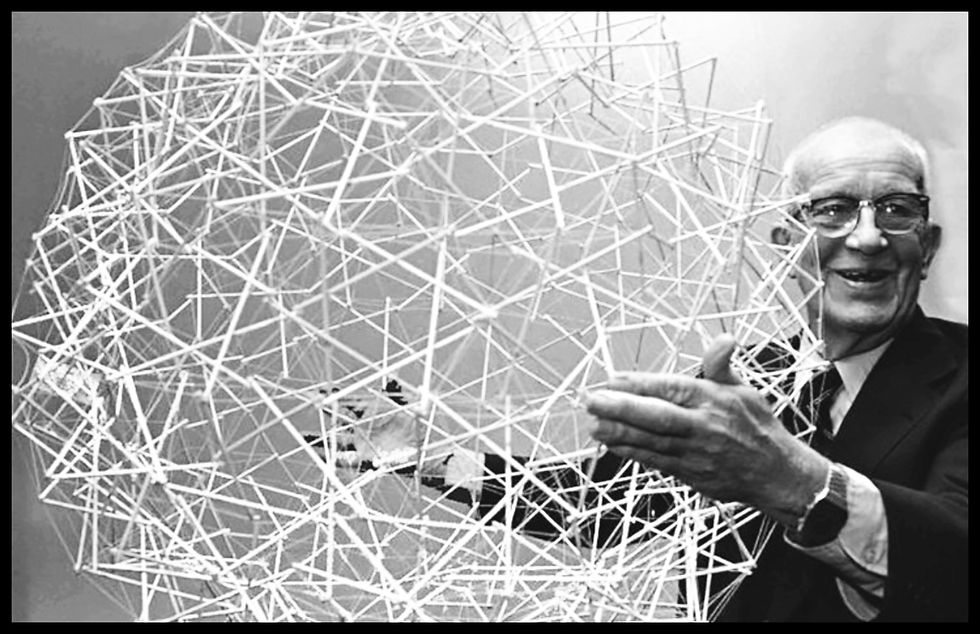
"Bucky has taken it in directions that are very much his own, that is to say, he absorbed my idea into his geodesic domes, the spherical ones, and I have never had any involvement with that aspect. In 1955 or 1956 he invented the word tensegrity. That’s a problem because what he did in his book was to go back to 1927 to demonstrate that what he did at that earlier date also deals with the tensegrity idea."
-Kenneth Snelson
This controversy raises the concern of Bucky's integrity — it was his professorship that inspired Snelson to explore such ideas, but this pattern of not crediting the brilliant work that informed his public showcases is something that has made people dismiss Synergetics. Our work with Synergetics University is not to defend Fuller's shortcomings, but to present the generalized principles of Universe and the work of brilliant trimtabs that uncover them. Bucky was a flawed human being AND he created what we believe to be two of the most important books of our time: Synergetics 1 & 2. Tensegrity fits right into Synergetics — telling a crucial part of the story of relationships and how no two "things" can occupy the same space at the same time; Instead, objects are attracted to one another by lines of force when in critical proximity to one another. This is modeled beautifully by this floating compression, this Tensegrity.


Snelson wasn't the first to explore such structures though — Karlis Johansons exhibited his "self-tensile constructions" in 1921. These tension structures became a part of the Bauhaus curriculum in Europe, although Snelson never cited Johanson's work as an inspiration.
"The tension-bearing members in these structures—whether Fuller’s domes or Snelson’s sculptures—map out the shortest paths between adjacent members (and are therefore, by definition, arranged geodesically). Tensional forces naturally transmit themselves over the shortest distance between two points, so the members of a tensegrity structure are precisely positioned to best withstand stress. For this reason, tensegrity structures offer a maximum amount of strength for a given amount of building material."
-Don Ingber "The Architecture of Life"
Tensegrity & Synergetics

700.011
The word tensegrity is an invention: it is a contraction of tensional integrity. Tensegrity describes a structural-relationship principle in which structural shape is guaranteed by the finitely closed, comprehensively continuous, tensional behaviors of the system and not by the discontinuous and exclusively local compressional member behaviors. Tensegrity provides the ability to yield increasingly without ultimately breaking or coming asunder.
700.04
All structures, properly understood, from the solar system to the atom, are tensegrity structures. Universe is omnitensional integrity.
713.07
Convergence: While we cannot see the intervals between atomic-event waves, the tensegrity structuring principles inform our consideration of the invisible events. Every time we instrumentally magnify the illusionarily converging geometrical "lines" defining the edges of "solids," we see them only wavilinearly converging toward critical proximity but never coming completely together; instead, twisting around each other, then slivering again, never having gone through the same "points."
"Universe has its radially explosive, compressional, outwardly push-ing radiation and omniembracing, intertensing gravity. The total of cosmic radiation (compression) and the total of cosmic gravity (tension) comprise equal amounts of energy. Gravitation and radiation, however, operate differently. Their respective interpatternings differ. Radiation is beamable (i.e., focusable). Radiation has shadows, whereas gravity has none. Unfocusable gravity is always comprehensive; tension is always embracingly comprehensive of compression. Compression and radiation are always open-ended systems. Tension and gravity are always closed systems."
-Buckminster Fuller "Cosmography"
"In a tensegrity structure, radiation/matter is modeled by the discontinuous struts, and gravitation is modeled by the continuous network of wires unifying the structure. This model reconciles these two disparate elements into a single unified field. No other known model does so."
-Buckminster Fuller "Cosmography"


"Look around; nature's been using tensegrity all along. Humanity was able to overlook this structural truth for thousands of years because tension tends to be invisible. Seeing rocks sitting on the ground and bricks piled upon bricks, we have developed a virtually unshakable "solid-things" understanding of how Universe works. The ubiquitous tension forces, from gravity to intermolecular attraction, tend to be more subtle."
-Amy Edmondson "A Fuller Explanation"
Tensegrity Now

The word Biotensegrity was coined by Orthopedic surgeon Dr. Stephen Levin in the 80's. Levin proposed that the body is not a compressive stack of bones, but rather, the bones are compression struts that are suspended by a matrix of overlapping biological "cables" like Fascia, muscles and connective tissues.
Thomas Myers' "Anatomy Trains" explores the idea of the body as a tensegrity system, held in dynamic tension by the Fascia. This book has become required reading in many Physical Therapy, Chiropractic and massage courses and has brought a resurgence in interest in integrity systems and design.
"Notice that spiderwebs, trampolines, and cranes, as wonderful as they are, are anchored to the outside and are thus not ‘finitely closed’. Every moving animal structure, including our own, must be ‘finitely closed’, i.e. independent, and able to hang together whether standing on your feet, standing on your head, or flying through the air in a swan dive. Also, although every structure is ultimately held together by a balance between tension and compression, tensegrity structures, according to Fuller, are characterized by continuous tension around localized compression."
-Tom Myers "Anatomy Trains"
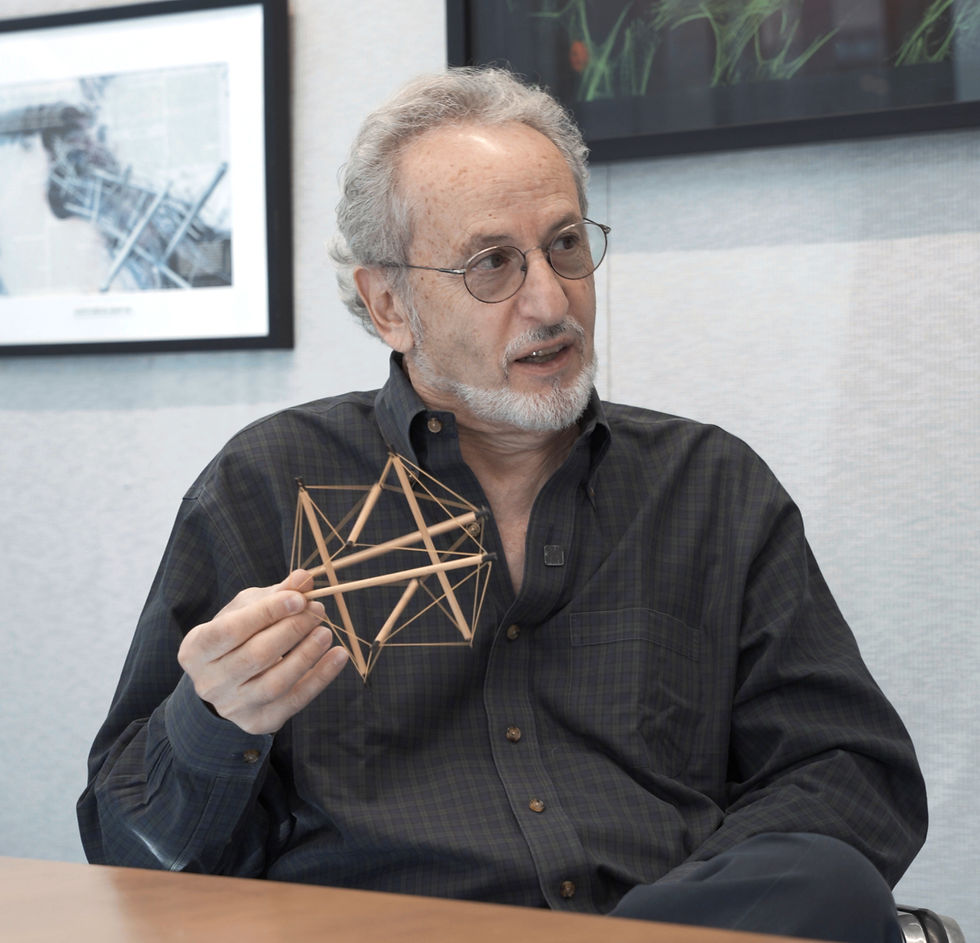
Don Ingber, the head of the Weiss Institute at Harvard has drawn significant attention to Tensegrity as his work has uncovered the tensegrity nature of cells.
"from the molecules to the bones and muscles and tendons of the human body, tensegrity is clearly nature’s preferred building system. Only tensegrity, for example, can explain how every time that you move your arm, your skin stretches, your extracellular matrix extends, your cells distort, and the interconnected molecules that form the internal framework of the cell feel the pull—all without any breakage or discontinuity."
-Don Ingber "The Architecture of Life"

Tensegrity Model of a cell was built with dowels and elastic cords. Don Ingber "The Architecture of Life"
"The geodesic structure found within the cytoskeleton is a classic example of a pattern that is found everywhere in nature, at many different size scales. Spherical groups of carbon atoms called buckminsterfullerenes or buckyballs, along with viruses, enzymes, organelles, cells and even small organisms, all exhibit geodesic forms. Strangely, few researchers seem to have asked why this is so. My view is that this recurrent pattern is visual evidence of the existence of common rules for self-assembly. In particular, all these entities stabilize themselves in three dimensions in a similar way: by arranging their parts to minimize energy and mass through continuous tension and local compression—that is, through tensegrity."
-Don Ingber "The Architecture of Life"
Conclusion

Whether you call it Floating Compression, or you call it Tensegrity, this principle of continuous tension and discontinuous compression is central to Synergetic accounting. Snelson and Johansons are trimtabs in Design Science, uncovering generalized principles through their artistic explorations of the constraints of space. Although Fuller failed to acknowledge the contributions of many great trimtabs along the way, it is our mission to draw connections and relationships through hypertext and acknowledgement in our modules here on this education Platform.
We are excited to see how biological engineering and the study of biological systems will reveal ever more layers to this Tensegrity conversation. If universal systems are operating in tensional integrity, how can we build models and relationships that work with these forces, not against them? Whether it is cells and fascia, the movements of planets held by gravity, or the tension of our ideas with what we create ~ Tensegrity could hold the keys to our omni-considerate future of systems and relationships.




Comments